
Brown’s proposed Buffalo budget deals with reality; OTB is about to

Mayor Byron Brown’s proposed 2023-2024 City Budget demonstrates a new reality:  Buffalo must deal with financial issues head-on.  Past budgets have relied on if-come revenues from new city sources, exaggerated estimates of established funding streams, and new money from other levels of government to cover the city’s expenses.  With a proposed increase in property taxes and higher fees for sanitation services, city government is coming to see that its financial future requires taking ownership of their problems.

No one likes to see their taxes go up. It is true that there is substantial poverty in Buffalo. It also is true that city property taxes are the lowest in the region. City property taxes, unlike in the towns and cities in the areas outside of Buffalo, include the city government’s $70.8 million contribution to the operations of the Buffalo School System rather than a separate levy for the school district. City government has not increased its funding for the school system in many years. More than 80 percent of Buffalo school district revenues come from the state.

The Mayor has proposed a 3.83 percent increase in property taxes and an 8 percent increase in sanitation fees for residential properties, the latter move planned to allow fees to match actual expenses.  Fire and snow removal vehicles are being added and improvements will be made to city parks.

The revenue increases are needed to allow the city to get closer to having current revenues paying for current expenses, which is the targeted standard for a government that is operating in a fiscally sound manner.  The increases in 2023-2024 will need to be followed by additional increases in the following years to steady the ship.

Not a part of the budget but coming at what might be considered an incredibly inopportune time, the City’s Citizens Salary Review Commission has proposed substantial pay raises (12.63 percent) for the mayor, comptroller, councilmembers, and school board members.  They all saw substantial raises in 2019.

There is some opposition to the raises, but it doesn’t appear that there are enough “no” votes at this time to eliminate or reduce the proposed increases.  Challengers in the Council primaries are highly likely to fight the increases, but four of the nine councilmembers have no election opposition and have therefor, in effect, already been elected.  Two others are lame ducks who do not necessarily need to pay attention to what the voters might say. 

There is some irony in the fact that Brown in 2021 criticized his mayoral opponent, India Walton, for proposing up to a three percent increase in property taxes.  During that campaign Brown incorrectly claimed that a three percent increase in property taxes would cost a taxpayer an additional $300 for a home valued at $100,000.  The Message from the Mayor introducing his 2023-2024 budget reports that the 3.83 percent increase in the property tax levy would increase the cost of that $100,000 home by just $46.

This year Walton is a candidate for the Masten District Council seat.  What might she or the other challengers in the other four districts say?  It will be interesting to see how the budget and pay raise issues play out in the Council campaigns.

OTB’s new Board

Tucked in a budget bill known in Albany as the “big ugly” is legislation that will significantly change the structure and management of the Western Regional Off-Track-Betting Corporation (OTB).  It’s been a long time coming.

Created 50 years ago to reduce illegal horse race betting and to distribute funds to its member counties and cities, OTB has gone off in various directions.  Betting parlors were created through the 15-county region.  Over time the Corporation set up online betting, bought a racetrack, opened a casino, and purchased a hotel adjacent to the racetrack.  Interest in horse betting has declined and many parlors have closed; those remaining all lose money – money that could be distributed to its members.

What has really done in OTB as much as anything has been its poor management.  Not only does the organization continue to employ people and pay operating expenses in betting parlors that lose money, but it has allowed its high-ranking staff and board members to be highly compensated and treated to perks that don’t usually come to people associated with a public corporation.  Investigations by the State Comptroller’s Office, the FBI and more recently the Erie County Comptroller’s Office have exposed some of those dealings.  OTB management and Board leadership have defiantly fought not only the suggested reforms but even the provision of information about how they operate.  My February 21, 2023, blog post highlighted the issues. Off-Track Betting in Western New York is off track | Politics and Other Stuff (politicsandstuff.com)

The new state legislation, which has been pushed by Senator Tim Kennedy and Assemblywoman Monica Wallace, immediately terminates the current 17 member OTB Board, where each member had an equal vote regardless of its population or customer base for the system.  In its place there still will be 17 members, but the voting strength of the members will be proportional to their population.  Erie County will have 24 votes; Buffalo will have 10; Monroe County will have 20; Rochester will have 8; Niagara County will have 8.  The remaining 12 counties collectively will have 30 votes.  Whoever is selected as Chair will have one extra vote.  In counties with county executives those officers rather than the legislatures will now select their counties’ representatives.  Mayors will appoint the representatives in Buffalo and Rochester.

There has been some complaining from the rural counties that will have diminished control over the Corporation.  They will likely lose some patronage and the perks their Board members have been receiving.  Evidently those folks are not familiar with such concepts as proportional representation and one-person-one-vote.

The new OTB has a lot of work to do once it gets its new board members in place, but their agenda has been laid out for them by the investigators who have exposed the many operational problems of the organization.  As the announcer says at the harness track when the horses reach the starting line, “and they’re off!”

Twitter @kenkruly
Related articles

This Trumpist threat proved itself a danger — now it’s forming again


By Alexander Lowie, Postdoctoral associate in Classical and Civic Education, University of Florida

Stewart Rhodes, the founder of the Oath Keepers, a far-right militia, announced in November 2025 that he will relaunch the group after it disbanded following his prison sentence in 2023.

Rhodes was sentenced to 18 years in prison for seditious conspiracy and other crimes committed during the U.S. Capitol riot on Jan. 6, 2021.

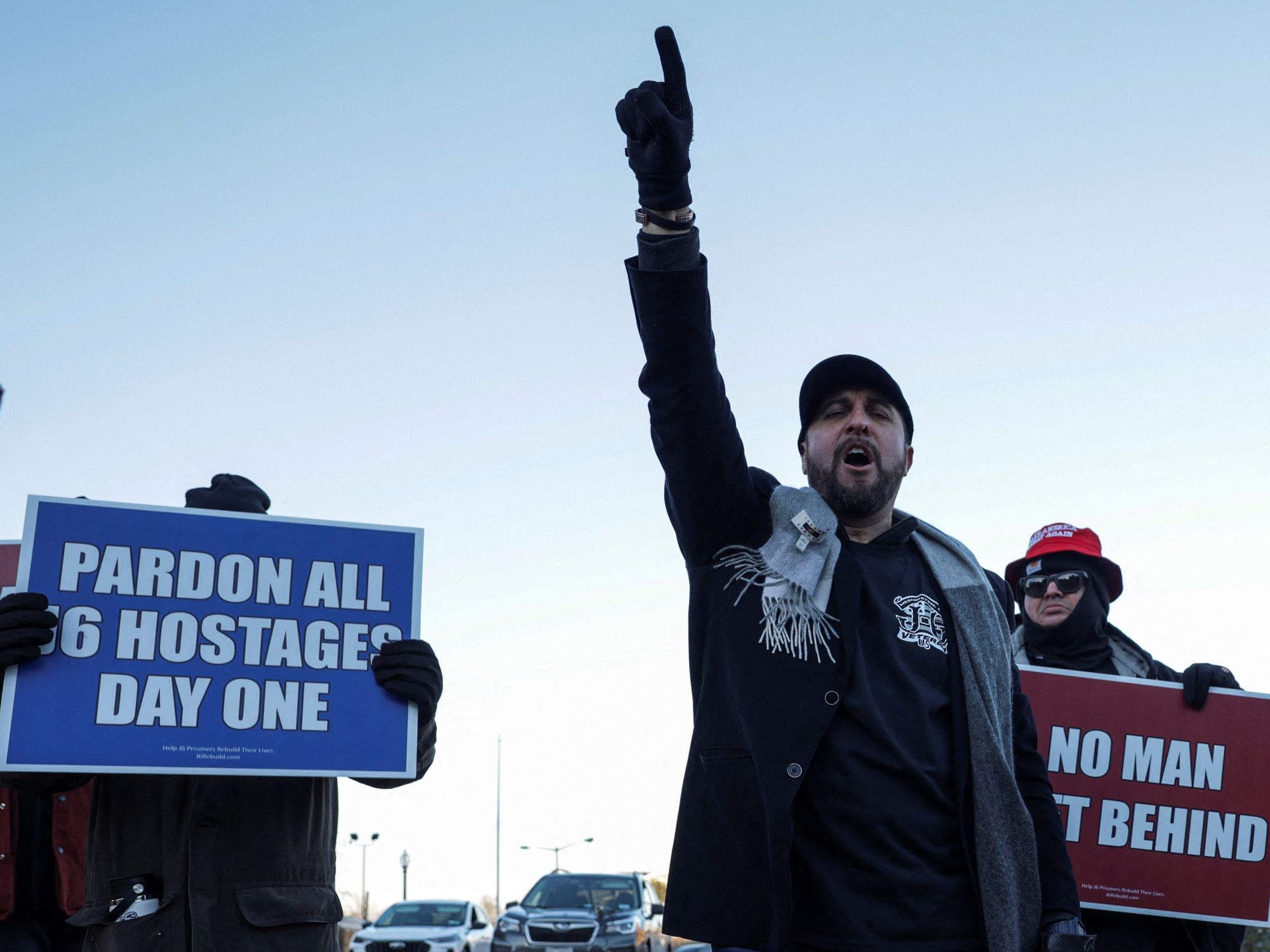
In January 2025, President Donald Trump granted clemency to the over 1,500 defendants convicted of crimes connected to the storming of the Capitol.

Trump did not pardon Rhodes — or some others found guilty of the most serious crimes on Jan. 6. He instead commuted Rhodes’ sentence to time served. Commutation only reduces the punishment for a crime, whereas a full pardon erases a conviction.

As a political anthropologist I study the Patriot movement, a collection of anti-government right-wing groups that include the Proud Boys, Oath Keepers and Moms for Liberty. I specialize in alt-right beliefs, and I have interviewed people active in groups that participated in the Capitol riot.

Rhodes’ plans to relaunch the Oath Keepers, largely composed of current and former military veterans and law enforcement officers, is important because it will serve as an outlet for those who have felt lost since his imprisonment. The group claimed it had more than 40,000 dues-paying members at the height of its membership during Barack Obama’s presidency. I believe that many of these people will return to the group, empowered by the lack of any substantial punishment resulting from the pardons for crimes committed on Jan. 6.

In my interviews, I’ve found that military veterans are treated as privileged members of the Patriot movement. They are honored for their service and military training. And that’s why I believe many former Oath Keepers will rejoin the group – they are considered integral members.

Their oaths to serving the Constitution and the people of the United States are treated as sacred, binding members to an ideology that leads to action. This action includes supporting people in conflicts against federal agencies, organizing citizen-led disaster relief efforts, and protesting election results like on Jan. 6. The members’ strength results from their shared oath and the reverence they feel toward keeping it.

Who are the Oath Keepers?

Rhodes joined the Army after high school and served for three years before being honorably discharged after a parachuting accident in 1986. He then attended the University of Nevada and later graduated from Yale Law School in 2004. He founded the Oath Keepers in 2009.

Oath Keepers takes its name from the U.S military Oath of Enlistment, which states:

“I do solemnly swear (or affirm) that I will support and defend the Constitution of the United States against all enemies, foreign and domestic; that I will bear true faith and allegiance to the same; and that I will obey the orders of the President of the United States …”

Informed by his law background, Rhodes places a particular emphasis on the part of the oath that states they will defend the Constitution against all enemies, foreign and domestic.

He developed a legal theory that justifies ignoring what he refers to as “unlawful orders” after witnessing the aftermath of Hurricane Katrina. Following the natural disaster, local law enforcement was assigned the task of confiscating guns, many of which officers say were stolen or found in abandoned homes.

Rhodes was alarmed, believing that the Second Amendment rights of citizens were being violated. Because of this, he argued that people who had military or law enforcement backgrounds had a legal duty to refuse what the group considers unlawful orders, including any that violated constitutionally protected rights, such as the right to bear arms.

In the Oath Keepers’ philosophy, anyone who violates these rights are domestic enemies to the Constitution. And if you follow the orders, you’ve violated your oath.

Explaining the origin of the group on the right-wing website The Gateway Pundit in November 2025, Rhodes said: “We were attacked out of the gate, labeled anti-government, which is absurd because we’re defending the Constitution that established the federal government. We were labeled anti-government extremists, all kinds of nonsense because the elites want blind obedience in the police and military.”

Rebuilding and restructuring

In 2022, the nonprofit whistleblower site Distributed Denial of Secrets leaked more than 38,000 names on the Oath Keepers’ membership list.

The Anti-Defamation League estimated that nearly 400 were active law enforcement officers, and that more than 100 were serving in the military. Some of these members were investigated by their workplaces but never disciplined for their involvement with the group.

Some members who were not military or law enforcement did lose their jobs over their affiliation. But they held government-related positions, such as a Wisconsin alderman who resigned after he was identified as a member.

This breach of privacy, paired with the dissolution of the organization after Rhodes’ sentencing, will help shape the group going forward.

In his interview with The Gateway Pundit, where he announced the group’s relaunch, Rhodes said: “I want to make it clear, like I said, my goal would be to make it more cancel-proof than before. We’ll have resilient, redundant IT that makes it really difficult to take down … And I want to make sure I get – put people in charge and leadership everywhere in the country so that, you know, down the road, if I’m taken out again, that it can still live on under good leadership without me being there.”

There was a similar shift in organizational structure with the Proud Boys in 2018. That’s when their founder, Gavin McInnes, stepped away from the organization. His departure came after a group of Proud Boys members were involved in a fight with anti-fascists in New York.

Prosecutors wanted to try the group as a gang. McInnes, therefore, distanced himself to support their defense that they weren’t in a gang or criminal organization. Ultimately, two of the members were sentenced to four years in prison for attempted gang assault charges.

Some Proud Boys members have told me they have since focused on creating local chapters, with in-person recruitment, that communicate on private messaging apps. They aim to protect themselves from legal classification as a gang. It also makes it harder for investigators or activist journalists to monitor them.

This is referred to as a cell style of organization, which is popular with insurgency groups. These groups are organized to rebel against authority and overthrow government structures. The cell organizational style does not have a robust hierarchy but instead produces smaller groups. They all adhere to the same ideology but may not be directly associated.

They may have a leader, but it’s often acknowledged that they are merely a figurehead, not someone giving direct orders. For the Proud Boys, this would be former leader Enrique Tarrio. Proud Boys members I’ve spoken to have referred to him as a “mascot” and not their leader.

Looking ahead

So what does the Rhodes interview indicate about the future of Oath Keepers?

Members will continue supporting Trump while also recruiting more retired military and law enforcement officers. They will create an organizational structure designed to outlive Rhodes. And based on my interactions with the far-right, I believe it’s likely they will create an organizational structure similar to that of the cell style for organizing.

Beyond that, they are going to try to own their IT, which includes hosting their websites and also using trusted online revenue generators.

This will likely provide added security, protecting their membership rolls while making it more difficult for law enforcement agencies to investigate them in the future.

Republicans need Susan Collins to win reelection. Trump keeps going after her.

The Maine senator has consistently won reelection in a blue state thanks to support from independents and some Democrats.