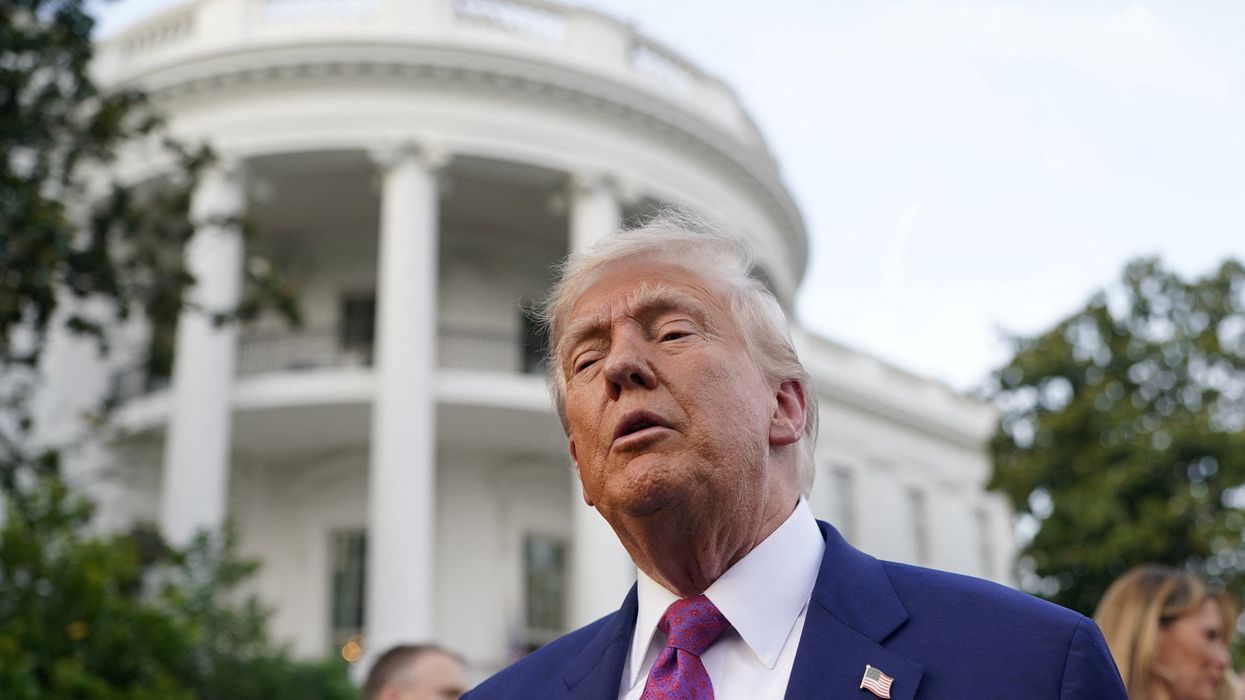

Many Instagram users this week had their scrolling interrupted by the bearded visage of our newly elected Vice President JD Vance. Suddenly it seemed that on the week of their inauguration, everybody on the app was following or being suggested to follow the official accounts of President Donald Trump and Vance (@POTUS and @VP, respectively).
Chaos ensued. In group chats, on Instagram Stories, on X, and Bluesky, people frantically wondered what was up. Some, like pop stars Gracie Abrams and Demi Lovato, said that when they tried to unfollow the VP and POTUS accounts, the app wouldn’t let them until they attempted multiple times. Other hashtags appeared to be banned or hidden, like #jan6 or #democrat.
Meta, meanwhile, has been busy assuring users that nothing new or weird is going on here. The accounts for the POTUS and VP, including their followers, were automatically handed over to the new administration as is customary during a presidential transition, while the accounts for Joe Biden and Kamala Harris previously under those usernames would be duplicated in an archive account. They’ve said it “may take some time for follow and unfollow requests to go through” but did not provide details when asked by the New York Times why that might be. Hashtags like #democrat were hidden, Meta said, due to “an error” that affected many hashtags, not just left-leaning ones (those hashtags are now visible).
The episode came just weeks after Meta, Instagram, and Facebook’s parent company, announced sweeping changes to the platforms: CEO Mark Zuckerberg said he would be firing Meta’s fact-checkers and relaxing standards for moderating posts in an effort to prevent “bias” and “censorship” — a move that was widely read as an attempt to curry favor with the Trump administration. Since 2018, Instagram and Facebook have deprioritized political and news content; now, it plans to bring these topics back to the forefront of users’ feeds.
Meta’s assurances that they are not boosting certain accounts or censoring others, and that these issues are no more than glitches may very well be true. But due to the secretive, black box nature of algorithms like Meta’s, it’s very hard to fact-check such claims.
Jillian York, author of Silicon Values: The Future of Free Speech Under Surveillance Capitalism, says that Meta has a long history of censorship. “We should not take Meta at their word for anything,” she says. “There’s a history of Meta saying, ‘This is a glitch,’ and what they really mean is internal bias, human error, or AI error. It’s unclear at this point which we’re talking about.”
For years, Republicans have believed that social media companies were inherently biased against conservative speech, despite evidence to the contrary. (More news influencers lean conservative, and most are male.) Now with a new Trump administration in power, it’s liberals who are expressing concern — and their fears, watchdogs say, are more reasonable than they might initially seem.
People worried about how Silicon Valley tycoons are kowtowing to Trump need not look far for an example of what conservative control of a platform might look like. “We saw this happen with X after Musk took over. My feed was completely different, and I think that’s possible with Meta too,” says York. Twitter was famous for its searchability, its transparency (you could see exactly who follows who, who liked what, what time a tweet was posted, and what was trending), and its allowance for free speech relative to other platforms.
“We should not take Meta at their word for anything.”
But under Musk, who describes himself as a free speech absolutist, censorship on X has gotten worse, not better. He banned links to competitor websites like Instagram and Substack, and admitted that X throttles posts that include any links at all, preventing users from accessing the kind of substantial, quality information found in news articles. He downranked tweets about Ukraine and appeared to limit views of posts that included words like “transgender,” “gay,” and “bisexual,” while allowing slurs for gay people to go unchecked. He dissolved the company’s Trust and Safety Council and boosted his own tweets so that they became inescapable for any user, regardless of whether they followed him.
Just like Musk pulled certain levers to make X a friendlier place for hate speech, spam, and AI slop, so too can any other platform. They can deprioritize links to certain websites (or any websites at all) so that posts that include them will receive fewer views. They can amplify hatred against minority groups while banning speech critical of the established order (for instance, under Meta’s new rules, writing “white people have mental illness” is prohibited on Facebook, while “gay people have mental illness” is allowed). They can, in theory, throttle users they deem problematic so that their posts don’t spread while boosting those who are sympathetic to their own interests.
Platforms can also limit transparency, as was the case when Meta got rid of CrowdTangle, the tool that allowed researchers and journalists to track what’s trending, how information spreads, and which accounts are driving it. TikTok, too, quietly killed its feature that allowed people to see how many views videos containing certain hashtags received. The move came after accusations that TikTok was boosting pro-Palestinian content due to the popularity of pro-Palestine hashtags, even though no evidence ever emerged that that was true.
All of the major platforms already filter “sensitive” topics (why else would so many people be using algospeak, like “seggs” or “unalive”?). There’s nothing stopping them from continuing to bury whatever they deem fit; several rights watch organizations have warned that Facebook and Instagram routinely censored pro-Palestine content.
On TikTok, many users complained that their algorithms seemed to lean more conservative after the app was offline in the US for several hours, then reinstated, perhaps a reflection of a shift in the user base that has been underway for months. The app welcomed users back with an announcement that explicitly thanked Trump, a rare move for a tech company. During the weekend’s inaugural events, TikTok sponsored a party celebrating the top 30 conservative influencers who helped secure Trump the election. In the days afterward, TikTok users claimed they couldn’t search for terms like “fascism” or comment “free Palestine.”
Though TikTok has denied that it is censoring this content, the problem is the same as it is with Meta: No one can be absolutely sure the company isn’t lying, and it’s no wonder people are suspicious.
Internet users fear more than just the erosion of trust in their social platforms: AI has made Google Search barely useable, filled Amazon, Etsy, and other storefronts with junk, populated social media with bots, and regurgitated misinformation to the millions of people who use tools like ChatGPT or Google Gemini. Humans have never spent more time online, but the spaces we’re in often make us mistrust everyone we interact with and everything we’re told.
Despite the backlash against the rightward swing of the major platforms, it’s curious that there isn’t a larger mass movement away from them. As Politico’s Derek Robertson wrote in Liberties Journal, so many of us feel like we’re hurtling toward a dystopian technocracy where human life and connection are continually degraded and devalued, and yet, “Why has a popular movement for technological self-governance failed to coalesce — something akin to the political movement inspired by the urbanist Jane Jacobs? Why, to return to our original question, don’t people care?”
It’s clear that people do care, but perhaps they feel as though their concerns won’t be heard unless they’re on the same platforms as everybody else, or that the platforms they’re on will morph into something unrecognizable. Perhaps we’re all just burnt out by the thought of building a presence on yet another new app — one that could, like all the others before it, only disappoint us in the end.