
Trump’s Air Force One ruse revealed war’s end is ‘further away than ever’: analyst
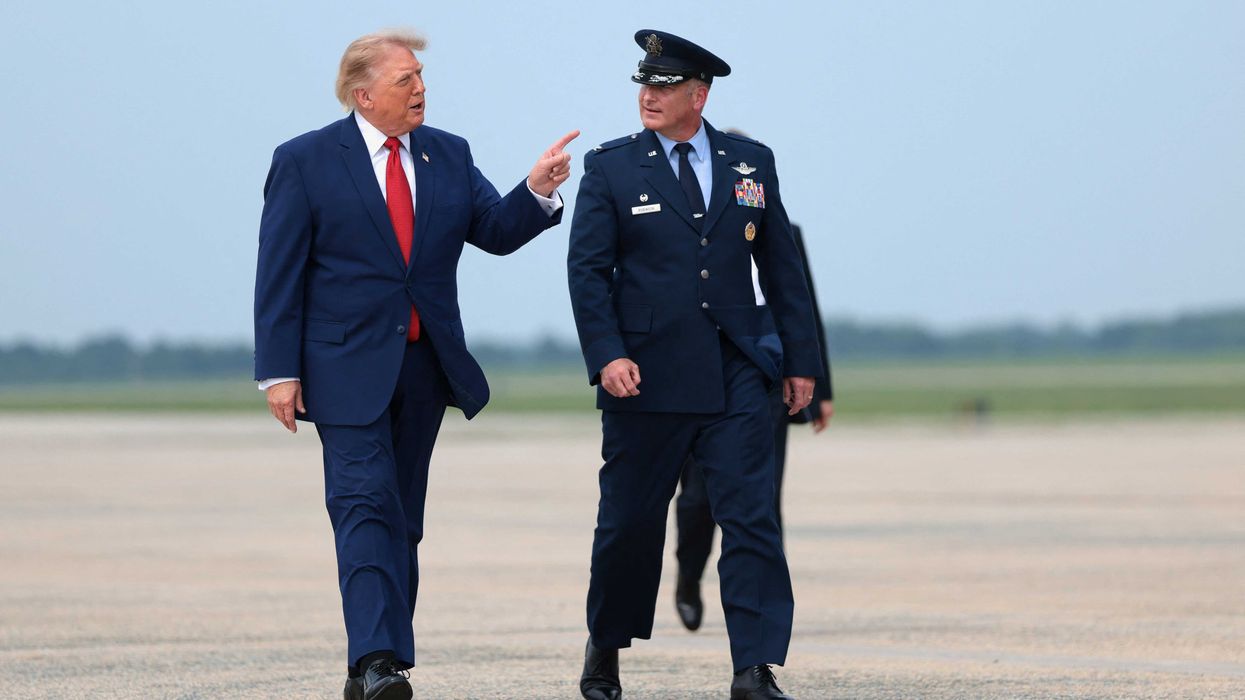
President Donald Trump's use of a decoy plane in Turkey and escape via a catering truck, with journalists none the wiser, was detailed in a new analysis for Slate by Ian Prasad Philbrick.
The plan, intended to avert an assassination threat, was basically "something out of a spy movie," Philbrick wrote.
"The catering truck, which typically loads in-flight meals, parked on the right side of Air Force One, partially shielded from media cameras," he wrote. As part of the ruse, Trump "crossed to the other side of the presidential plane after boarding and stepped into the truck’s elevated container," after which the catering truck lowered the container, drove to a military jet, and offloaded its human cargo to be routed home through the United Kingdom — without journalists or even some White House officials any the wiser.
One of the most shocking aspects of the whole affair, wrote Philbrick, is that the Trump administration was essentially using all the journalists who thought they were flying with the president "as bait" for any would-be assassination plot without letting them know.
Furthermore, he noted, after the flight, "asked why reporters had had to close their window shades when leaving Turkey, Trump failed to mention that he had switched flights. 'I’m No. 1 on their list,' he said, referring to Iran. 'But if I go, you go. Right?' As it turns out, maybe not."
Decoy flights are not completely unheard of for the president, Philbrick wrote — but it's still extremely uncommon.
"Officials were vague about George W. Bush’s whereabouts immediately after the Sept. 11 attacks, and Bill Clinton took an unmarked plane from India to Pakistan in 2000," wrote Philbrick. However, in these cases, "even Bush had reporters with him, and Clinton’s staff told at least one journalist about the switch beforehand."
Philbrick also took the ruse as a sign that Trump's war against Iran is not going well.
"In short, lasting peace seems further away than ever," he wrote.
Kash Patel faces deadline to swat down ‘inherently plausible’ drinking allegations

FBI Director Kash Patel has five days to respond to a motion arguing his own public record proves The Atlantic's drinking allegations are 'inherently plausible.'
Judge Emmet G. Sullivan set the Aug. 17 deadline after granting a joint extension request, according to the court docket. The Atlantic filed its motion to dismiss on July 27.
The Atlantic's April story, "The FBI Director is MIA," reported that Patel drank to excess, missed work, and posed a national-security risk. Patel called it false and sued for $250 million.
"Print it, all false, I'll see you in court—bring your checkbook," Patel told the magazine through his spokesman before it published.
The Atlantic's lawyers argue Patel cannot meet the legal standard required of public officials in defamation cases. That standard — called actual malice — requires proof that a publisher knew a story was false or strongly suspected it was, according to the filing.
"The Complaint does not come close to satisfying this demanding constitutional standard," the filing said. "It does not allege a single fact showing that any statement in the Article is false, much less that Defendants had 'serious doubts' or 'actual knowledge of falsity' for any of these statements."
The filing goes further, arguing Patel's own public behavior undercuts his suit, according to the motion.
"The Article itself shows that the Allegedly Defamatory Statements are not implausible," the filing said, "but rather inherently plausible."
The filing said reporter Sarah Fitzpatrick spoke to more than two dozen sources, according to the motion. They included current and former FBI officials, members of Congress, and hospitality workers.
Six sources confirmed that briefings had to be rescheduled because of Patel's alcohol-fueled nights, the motion said.
Nine sources confirmed he panicked when a computer malfunction led him to believe he had been fired, according to the filing.
The story described officials telling Fitzpatrick that Patel's security detail had difficulty waking him on multiple occasions, and that a request was made for specialized breaching equipment — tools normally used by SWAT teams — because he was unreachable behind locked doors, according to the filing.
The filing noted that Patel's drinking was already a matter of public record before the story ran.
In February, Patel was filmed chugging beer in the U.S. men's Olympic hockey team's locker room in Milan. FBI headquarters was simultaneously managing a cartel violence outbreak in Mexico, CNN reported.
Days after The Atlantic published, a 2005 letter from Patel's Florida Bar application — obtained by The Intercept — disclosed he had been arrested twice on alcohol-related charges, once for public intoxication in 2001 and once for public urination after leaving a bar in 2005.
The story's fallout reached Capitol Hill the following month, according to Senate records.
At a May budget hearing, Patel agreed to take an alcohol use disorders test after Sen. Chris Van Hollen (D-MD) demanded it. Patel called the allegations "a total farce."
The Atlantic suit is the latest in a long line, according to the motion.
A federal judge in Texas dismissed Patel's defamation suit against MS NOW analyst Frank Figliuzzi the day after Patel filed against The Atlantic. The judge called Figliuzzi's comment about Patel's nightclub visibility "rhetorical hyperbole."
None of Patel's five defamation suits has succeeded, according to the filing.
Patel's response is due Aug. 17. The Atlantic's reply is due Aug. 31.