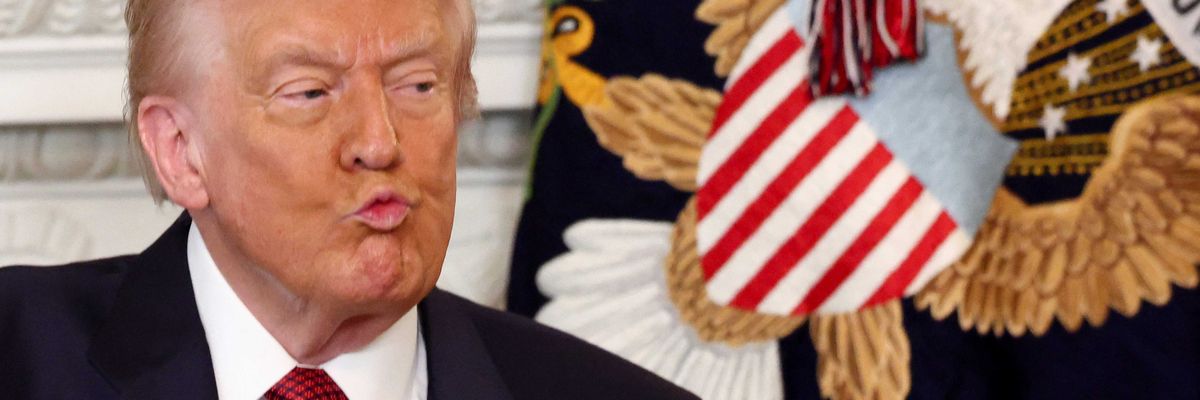

President Donald Trump tours a migrant detention center, dubbed “Alligator Alcatraz,” located at the site of the Dade-Collier Training and Transition Airport in Ochopee, Florida, on July 1, 2025. | Andrew Caballero-Reynolds/AFP via Getty Images
For the past two years, Donald Trump and the Republican Party could reasonably claim to have broad support for their anti-immigrant agenda. The public wanted less immigration, Trump promised to provide it, and much of the public trusted him to act.
But things look a lot different now that he’s actually implementing that agenda.
After a years-long surge in opposition to immigration, Americans’ views seem to be getting more positive toward it, a score of new data suggest. And while there’s still some support for some of Trump’s policies, Americans are souring on the extreme parts of Trump’s approach.
Six months into Trump’s term, the American public’s tendency to swing in the opposite direction of the president’s policy vision seems to be reaching immigration as well. And compounding this apparent “thermostatic” shift is that it’s happening as Trump actually achieves what he promised. Crossings at the southern border hit a historic low last month, and he has secured billions in additional funding for border security and expanded enforcement operations.
What gives? Is the public really that fickle? Is Trump overreaching? And perhaps more importantly, will this shift be durable? The data we have offers some mixed answers, but it largely points in a worrisome direction for Trump and his party. As with the economy, government efficiency, foreign policy, and trade, Americans seemed to like Trump’s ideas in theory. Seeing them in practice is another matter.
What we know for sure: The public is warming to immigration
The high-quality public opinion data we have shows a pretty dramatic reversal in the public’s attitudes toward immigration. That shift is astounding given how aggressively the public was embracing an anti-immigrant attitude during the Biden years.
As a refresher: Worsened by record asylum claims and spikes in border crossings, public sentiment moved quickly toward restrictionism and in favor of Trump’s campaign proposals. Effective campaigning and sensationalizing by Republicans for most of 2022 and 2023, along with media scrutiny of the effects of immigrant arrivals in major cities, only heightened the public’s concerns ahead of the 2024 campaign year.
And so, for the past two years, the country seemed primed to tolerate more aggressive enforcement and stricter border policies. Last year marked a kind of watershed in this vibe shift: It was the first time since 2019 that a plurality of Americans labeled immigration as “the most important problem facing the US,” and the first time since 2005 that a majority of the country wanted less immigration, per Gallup’s tracking surveys. Polls were routinely capturing significant openness to mass deportations, ending birthright citizenship, holding undocumented immigrants in large detention centers or encampments, and a range of other policies that seem extreme when judged by how the public felt when Trump first entered politics, centering a similar message.
Those attitudes explain why Trump’s campaign bet that pledging harsher immigration policies would be a political boon. And they explain why popular support for Trump’s handling of immigration remained resilient for the first few months of this presidency, even as his other approval ratings began to slide.
But that durability has begun to crack. In Gallup polling, the share of Americans who want to lower rates of immigration has dropped from 55 percent in 2024 — the highest level in two decades — to 30 percent this year. Meanwhile, the share who want rates of immigration to stay the same or increase has sharply risen, across all cohorts, including Republicans. And more generally, after a steady increase over the Biden presidency in the share of Americans who say immigration is a “bad thing” for the US, the trend has reversed. A record share of the country now says immigration is a good thing for the country — 79 percent. That figure is even higher than it was back in Trump’s first term, when he first tried to crack down on both legal and illegal migration, asylum, and the southern border, and similarly provoked the country into supporting immigration.
Gallup’s poll, and the Pew Research Center’s own surveys, also show some other signs of the public’s attitudes straying from the Trumpist position. Support has risen toward pro-immigrant policies. Compared to a year ago, more Americans support legalization proposals for both DREAMers (those undocumented immigrants who were brought to the US as children) and for undocumented immigrants in general. Both proposals now have the support of at least eight in 10 Americans.
Conversely, support for more aggressive enforcement policies has declined: Fewer Americans support “significantly” hiring more Border Patrol agents and “deporting all immigrants” to their home countries than did a year ago.
The Pew survey adds some important context for these shifts: Americans broadly disapprove of Trump’s handling of immigration so far, and specifically reject Trump’s highest-profile moves. Some 60 percent of Americans oppose Trump’s suspension of asylum programs and Temporary Protected Status policies. More than half oppose increasing ICE raids on workplaces and building more holding centers for undocumented immigrants awaiting deportation cases, for which Trump’s recent tax cuts and spending law allocates $75 billion in funding. And only 37 percent of Americans back the idea of deporting undocumented immigrants to El Salvador, as epitomized by the controversy over Kilmar Abrego Garcia.
As CNN’s Aaron Blake pointed out this month, polls over the past few weeks all suggest something similar: Democrats, independents, and even some Republicans are feeling like Trump, and his administration, are going “too far” in how they’re enforcing their policies, particularly deportations. And the overall trend, shown in Gallup, Pew, and in polling averages, is declining approval of Trump’s approach so far.
What is less clear: How durable this dissatisfaction with Trump will be
Still, the data paints a more mixed picture of just how long and steady this openness to immigration will remain. And it’s not clear if it will be enough for the public to act against Trump.
The Pew survey — which was conducted partially before protests against large-scale ICE raids began in June — shows that there are still some Trump policies with split public support. For example, about half of Americans support “using state and local law enforcement to aid federal deportation efforts,” assigning more federal employees to work on deportations, and offering financial support to undocumented immigrants who “self-deport.”
Support for deporting undocumented immigrants convicted of violent and nonviolent crimes remains high as well. And at least one core Trump promise is now mainstream: support for extending border wall construction along the US-Mexico border has majority support, seeing increases across partisan lines.
This openness to some of Trump’s positions demonstrates the complexity of public opinion on immigration. Americans often make more sweeping declarations when asked about the general contours of an immigration policy question. But when provided with details and given more specific conditions and qualifications, they often endorse contradictory opinions, or an “all-of-the-above” approach.
We also don’t have enough data at this point to judge just how much immigration policy, and Trump’s handling of it, matters to Americans, or if it will push them to punish Trump and his party during elections this year and next. Immigration is also no longer the main concern of most Americans — it’s preserving democracy, or the economy, per recent polling from Quinnipiac. And across the surveys we do have, public views seem to be confused about just what the ramifications of Trump’s approach will be: Will it cost American taxpayers money? Will it make the economy weaker? Will it lead to less crime and make the country safer? A strong majority opinion has not formed on any of these questions yet.
In other words, the stakes of Trump’s immigration policies aren’t very clear to most Americans — or they need more time, and to see more developments of Trump’s policies play out, before deciding whether to punish Trump and his party for it. For the time being, the Trump administration seems intent on pushing forward with this more extreme agenda: Trump toured the Florida migrant detention center known as “Alligator Alcatraz” this month and the National Guard remains deployed in Southern California, while his administration has fired immigration judges and ended bond hearings for detained immigrants in a push to streamline mass deportations and detentions. It seems like they are betting that the public will eventually come around to their position, either by normalizing their more extreme policies, or wearing out public opinion. That could still work — but the overall trend seems to be dissatisfaction, and if the administration does not change course, that trend looks more likely than not to continue.